
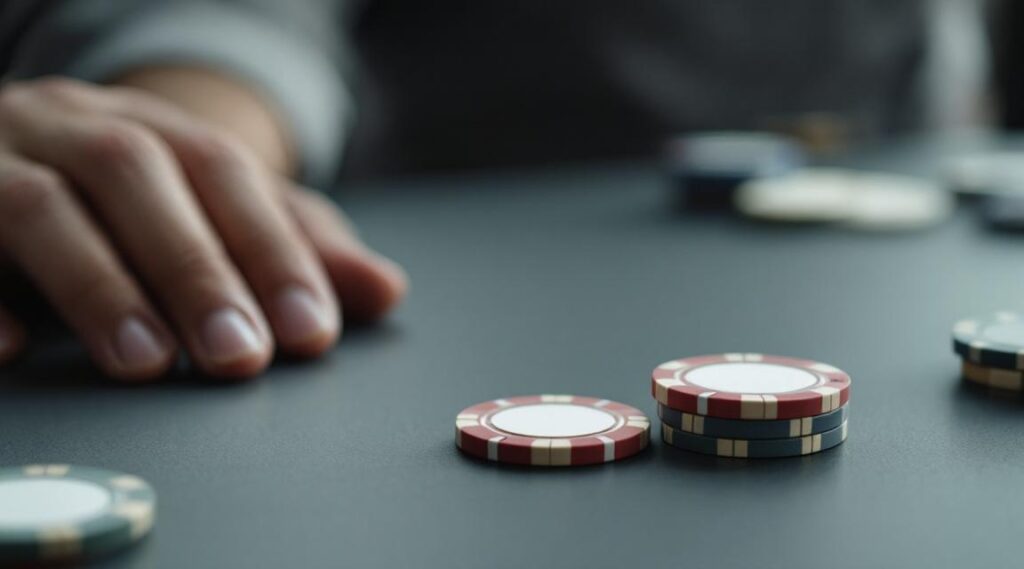
Divide one dollar by the smallest bet a game will take and you have the answer. At a cent a spin the quotient is one hundred. At ten cents it is ten. At a dollar a hand it is one. Those three numbers are fixed before the deposit lands, and nothing else about the account changes them.
Readers of this site already run that calculation on other balances. A community currency only means something once you can say what a unit buys, which is what this site’s own guide to building and running one spends most of its time on.
A casino balance behaves the same way. The unit price sits in the game’s own rules, published before anyone stakes anything, and the division is as blunt as it looks.
What follows is that arithmetic for a one dollar balance at a Canadian site, including the part where it runs out. The stake figures come from a comparison page that lists minimum bets game by game. The timings come from Ontario’s rulebook, which fixes how fast a round may be played and says nothing at all about how little it may cost.
The stake minimum, not the deposit minimum, sets the count
A deposit minimum tells you what the cashier will accept. A stake minimum tells you what the game will accept. They are different numbers, set by different people, and only the first one ever appears in large type.
On the Canadian comparison list I read on 16 September 2026, the lowest verified stakes sat at C$0.01 on a handful of slot titles and at C$0.10 across low stakes roulette, keno and crash style games. The same reviewers could not verify a single blackjack game with a minimum bet below C$1.
Those figures cluster, and the clustering is what makes the arithmetic short. A one dollar balance does not divide into a spectrum of outcomes. It divides into one hundred rounds, ten rounds, or one. The figure that counts is the total for the round, so where a title prices per payline, twenty lines at a cent each makes a twenty cent spin and the count falls from one hundred to five.
Applying Ontario’s pace rule to each count gives the shortest time those rounds could possibly occupy.
|
Game Type |
Lowest Stake on the Canadian List |
Rounds a C$1 Balance Covers |
Fastest Those Rounds Could Run |
|
Slots at One Cent |
C$0.01 |
100 spins |
4 minutes 10 seconds |
|
Slots at Ten Cents |
C$0.10 |
10 spins |
25 seconds |
|
Low Stakes Roulette |
C$0.10 |
10 spins |
25 seconds |
|
Keno and Crash Games |
C$0.10 |
10 rounds |
25 seconds |
|
Blackjack Hands |
C$1.00 |
1 hand |
2.5 seconds |
The last column is a floor, not a forecast. A live wheel spins far slower than that, and a dealt hand runs at human speed. The floor is still worth stating, because it is the only part of the pace the province fixed: ten rounds at ten cents cannot legally run in under 25 seconds.
A longer count is not a better one. The dollar is the same dollar in every row, and the only thing changing down the column is how many pieces it gets cut into.
Ontario wrote the pace, not the price
Ontario’s competitive market opened on 4 April 2022, and the Registrar’s Standards for Internet Gaming published by Ontario’s Alcohol and Gaming Commission have applied since that day.
Standard 2.18 requires at least 2.5 seconds from the start of one game cycle to the start of the next, and it requires the player to release and press the start control for each one.
Three further standards close the obvious shortcuts. Slots may not offer autoplay. Turbo, quick spin and slam stop features are not permitted. The gaming system may not let anyone run several slot titles at once. A hundred rounds is therefore a hundred separate deliberate actions.
One more standard governs what the game may do with a small return. For slots, the system may not use winning sounds or visual effects for a return that is less than or equal to the amount just staked. A ten cent spin that pays back five cents may not be presented as a win, which is a rule about arithmetic rather than about atmosphere.
Read those standards end to end and you will not find a minimum stake in them, and no maximum either. The cent and the dime are commercial settings, chosen by the studio that built the title and the operator that licensed it, in the same way a mobile game picks the size of its smallest currency pack.
That asymmetry is the useful thing to carry away from the rulebook. The province decided how quickly a dollar may be spent. The companies selling the game decided how finely it may be divided, and they can change that figure on any title without asking a regulator first.
The exit has a number of its own
Every account has two thresholds. The low one is the deposit minimum, and it is the number that gets printed in big type. The high one is the withdrawal minimum, and it decides whether anything ever leaves.
gambling.com keeps a Canadian comparison page for every 1 dollar deposit casino its reviewers have tested at the cashier, and the figure it prints beside that entry floor is the one that really governs the account: at many of the listed sites, a balance has to reach C$50 before a withdrawal can be requested.
Set that beside the count and the shape of the problem is plain. The balance has to multiply by fifty, and it has to manage it inside the rounds listed above, because ten dimes is the entire budget unless the balance grows as it goes. A fiftyfold climb therefore rests on results the game produces rarely, not on staying at it longer.
Ontario requires operators to state their deposit and withdrawal rules clearly and specifically, which is why the cashier’s floor is printed somewhere in every set of terms. The standards do not say where that floor belongs, so the operator picks it, exactly as the studio picks the stake.
That page does not pretend otherwise. Its own answer to whether a dollar can reach C$50 is that the run would have to be highly favourable, and that most one dollar balances are gone before they get anywhere near it.
The balance cannot go below zero, and it can stall above it
The Ontario standards also settle what happens at the bottom. No player account may hold a negative balance, and no bet may be accepted that could produce one. The account cannot borrow against itself, and the operator may not extend credit or refer a player to anyone who would.
That gives the arithmetic a hard stop, and it creates a small oddity just above it. A balance of C$0.07 at a title with a ten cent minimum cannot be staked, because the bet would be refused, and cannot be withdrawn, because it sits far below the cashier’s floor. Unless another title on the site accepts a one cent stake, the remainder stays where it is.
The count is a division, not a prediction. Game specifications filed under the Ontario standards have to document the operator’s advantage in relation to each wager, along with the odds of winning for each prize. That advantage is an average measured across an enormous number of rounds.
Ten rounds say nothing about it. Slot outcomes come from chance, each cycle independent of the one before it, and no run of results changes what the next cycle will do. So the division has one ordinary ending: the rounds are used up and the balance reads zero. A short count can finish above zero instead, and the comparison page is blunt about how unusual that is.
What a dollar actually demonstrates
Ontario requires the machinery to stay visible while the count runs down. A player’s balance must be displayed in Canadian dollars at all times. A slots session must show the net position, meaning every win minus every loss since the session started. The site must give the player a way to track the passage of time, and must offer loss and deposit limits during registration.
That points to the honest description of a one dollar deposit. It is a demonstration of a cashier and a set of controls, priced at the cost of a demonstration. It shows whether the payment rail works, whether the balance displays properly, and where the limit settings live. At a cent a round it lasts about four minutes, and at a dollar a hand it is over in one.
None of this is a national answer, because Canada does not have one. Section 207 of the Criminal Code makes a lottery scheme lawful when a province conducts and manages it, so the answer changes at each provincial border.
The rulebook quoted throughout this piece is Ontario’s, and 19 is the age it sets. Alberta wrote its own under the province’s iGaming strategy and opened for private operators on 13 July 2026, with 18 as the age. In the other provinces the government site is the only lawful one, and its stake minimums are its own.
The help lines are provincial as well. ConnexOntario answers around the clock on 1-866-531-2600 for anyone in Ontario. In Alberta, the Alberta Health Services Problem Gambling Help Line is 1-866-332-2322. Both are free, and neither one requires an account with anybody.
A division problem is honest in a way a product page finds difficult. One dollar buys a hundred rounds, or ten, or one, and every one of those answers was knowable before the money moved. That is the useful part of the number, and it is the whole of it.
More Stories
Sweet‑Discord Marinades: How To Marinate Proteins For Perfect Sweet‑Savory Balance
SweetDiscord 7364 And 7364 Almonis Drive, Pados, IL 84076: What This String Could Mean (And Why It Matters)
7364 Almonis Drive, Pados IL & SweetDiscord: What We Know (2026 Guide)