
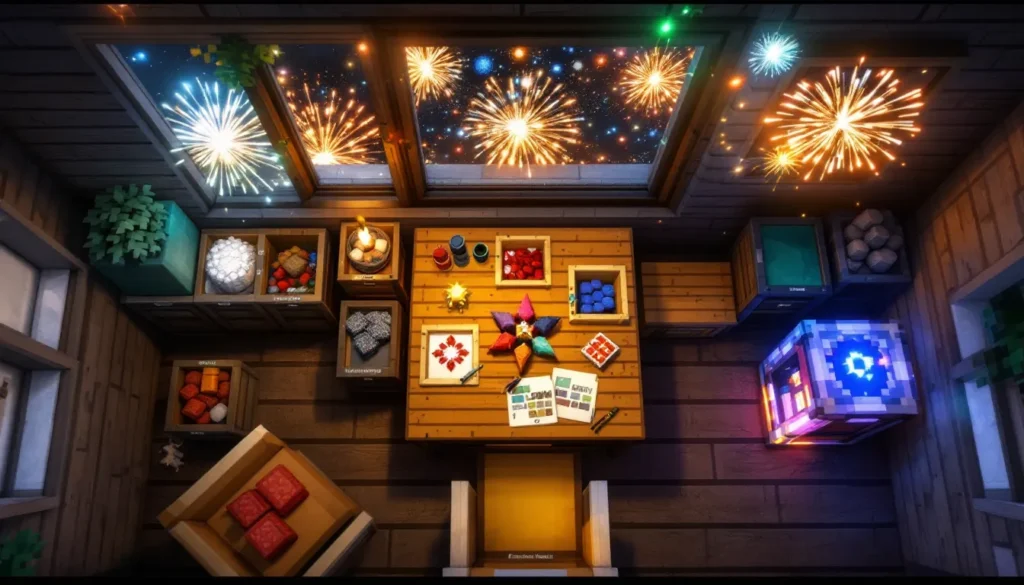
Fireworks in Minecraft are one of those features that separates a vanilla base from something genuinely spectacular. While most players think of fireworks as pure decoration, something to launch during celebrations, they’re actually a versatile crafting system with surprising depth. Firework stars are the core component that makes the whole thing work, and once you understand how to craft and combine them, you can create displays that’ll make any spectator stop and watch. Whether you’re building a celebratory show for your multiplayer server or just want to light up the night sky over your survival world, mastering firework stars is the foundation. This guide covers everything you need to know about crafting firework stars, the effects they produce, and how to combine them into truly memorable displays.
Key Takeaways
- Firework stars in Minecraft are crafted by combining gunpowder, dye, and optional modifiers (glowstone, diamond, feather, or gold nugget) to determine the color, shape, and special effects of your firework bursts.
- A single firework rocket can hold up to 8 firework stars simultaneously, allowing you to layer multiple colors and effects for complex, visually stunning aerial displays.
- Different modifiers create distinct effects: glowstone produces a twinkle, diamond adds falling particle trails, feathers create creeper-face shapes, and heads produce star-burst patterns.
- Multi-star fireworks and choreographed sequences—combined with proper timing, location, and thematic color choices—transform basic fireworks into memorable celebratory displays.
- Efficient resource farming (especially creeper farms for gunpowder) and batch-crafting stars before assembling fireworks saves time and materials during large-scale shows.
What Are Firework Stars and Why They Matter
A firework star is the intermediate ingredient that determines what happens when your firework explodes in the sky. It’s not the firework itself, that comes later, but rather the payload that defines the color, shape, and effects of the burst. Without a firework star, you just have a weak sparkler that fizzles out.
The star is crafted separately, then combined with gunpowder and paper to create the actual firework rocket. The beauty of this system is that one firework rocket can hold multiple stars, meaning a single launch can produce layered, complex bursts with different colors and effects all happening simultaneously. This is what separates a boring single-color bang from a genuinely impressive aerial display.
Understanding the firework star also helps with resource management. If you’re planning a big celebration, you need to know exactly how many stars you’ll need and what materials to farm. How to make a campfire in Minecraft might not sound related, but having a campfire nearby while you craft fireworks can be a useful marker for your crafting area. The star system lets you batch-produce components ahead of time, which is far more efficient than crafting entire fireworks one at a time.
How to Craft Firework Stars: Step-by-Step Instructions
Required Materials and Ingredients
Crafting a firework star requires gunpowder as the base, plus a dye for color. The core recipe is:
- Gunpowder (1 piece minimum)
- Dye (1 piece, any color from your choice of 16 options)
- Optional modifiers: Glowstone dust, diamond, head, gold nugget, or feather
Gunpowder drops from creepers, ghasts, or witches, or you can craft it from charcoal/coal, sulfur (if using mods), or saltpeter. Dyes come from flowers, bonemeal recipes, or can be crafted from various plant matter. The modifiers determine effects: glowstone creates a twinkling effect, diamond makes a trail, feather produces shape-burst particles.
Basic Crafting Recipe
The simplest firework star uses just gunpowder and a dye:
- Open your crafting table
- Place 1 gunpowder in the center
- Place 1 dye (any color) adjacent to the gunpowder
- Craft the star
You’ll get 1 firework star. The color of the dye you use directly determines the burst color when the firework detonates. This is straightforward but produces a standard burst with no fancy effects. If you want something more dramatic, modifiers are where the complexity comes in.
Creating Custom Colors and Effects
To add effects, you add a modifier to the gunpowder and dye:
- Open your crafting table
- Place 1 gunpowder in the center
- Place 1 dye adjacent to gunpowder
- Place 1 modifier (glowstone dust, diamond, gold nugget, feather, or head) adjacent to the gunpowder
- Craft the star
Each modifier produces a different effect:
- Glowstone dust: Creates a “twinkle” effect after the main burst
- Diamond: Adds a trail of particles falling from the burst
- Feather: Produces a creeper-face shape (a special burst pattern)
- Gold nugget: Creates a big ball explosion shape
- Head (any type): Makes a star-burst shape
You can use multiple modifiers in one star. For example, gunpowder + blue dye + glowstone + diamond creates a blue burst with both twinkle and trail effects. The more modifiers you add, the more visually complex the burst becomes. This is where creative experimentation starts paying off.
Different Types of Firework Stars and Their Effects
Basic Burst Fireworks
A basic burst is the simplest firework star effect: a single explosion of color with no additional particles. It’s created using just gunpowder and a dye, with no modifiers. When it detonates, it creates a simple radial burst in whatever color you chose. Basic bursts are reliable, predictable, and the building block for most displays. They’re also the cheapest option to produce, which matters when you’re crafting hundreds of firework stars for a massive show.
The trade-off is that basic bursts lack visual complexity. They’re functional but not memorable on their own. This is why layering multiple stars in a single firework becomes valuable, you can combine a basic burst with effect stars to create something more interesting.
Trail and Twinkle Effects
Trail effects (created by adding diamond to your star recipe) create a falling particle trail beneath the burst. When the firework explodes, the main burst happens, then small particles cascade downward like embers falling from the sky. This effect is visually stunning when combined with warm colors like red, orange, or gold.
Twinkle effects (glowstone dust) add a secondary sparkle effect after the initial burst fades. The burst happens, the particles spread, and then the remaining particles twinkle and fade more slowly. Twinkles work well with cool colors (cyan, purple, blue) and add an elegant, drawn-out finale to bursts.
You can combine both effects in a single star by including both glowstone and diamond in the crafting recipe. This creates a burst that has both a falling trail and a twinkling aftermath, visually complex and definitely worth the extra materials.
Shape Modifiers: Creating Unique Patterns
Shape modifiers change the burst pattern itself, not just add particles. A gold nugget creates a large ball shape, spreading particles in a wider, more defined sphere. A feather creates a creeper-face shape (a tribute to Minecraft’s iconic mob). A head (any type, skeleton, zombie, wither, dragon, etc.) creates a star-burst shape with points.
These shapes are game-changers for display design. A star burst from a dragon head looks completely different than a ball burst from a gold nugget. Game guides from Twinfinite often showcase how shape combinations can create themed displays, for example, using creeper-face bursts during a Creeper-themed celebration, or dragon-head shapes for an End-themed event.
Mixing shapes and colors strategically creates visual storytelling. Red and orange ball bursts feel chaotic and explosive, while blue and cyan star bursts feel elegant and controlled. Purple with creeper faces feels appropriately eerie.
Crafting Complete Fireworks: From Stars to Rockets
Combining Stars With Gunpowder and Paper
Once you have your firework stars, you need to assemble them into actual fireworks. The basic firework recipe is:
- 1 gunpowder (determines flight duration: 1 gunpowder = lower flight, 3 gunpowder = highest flight)
- 1 paper (the fuse/casing)
- 1+ firework stars (the payload)
Place these in a crafting table with the gunpowder in the center, paper above or below, and stars anywhere else in the grid. You get 1 firework per craft. The number of gunpowder pieces determines how high the firework travels before detonating, more gunpowder means a higher burst. 3 gunpowder is the maximum useful amount (it won’t go higher than that).
Paper comes from sugarcane and is usually abundant if you have a river or water source. Gunpowder is the limiting factor, so farm creepers or find witch spawners for efficient production.
Creating Multi-Star Fireworks
This is where displays get interesting. You can add up to 8 firework stars to a single firework rocket. The recipe stays the same, just add multiple stars instead of one:
- 1-3 gunpowder
- 1 paper
- 2-8 firework stars (any combination of colors, shapes, and effects)
When this firework detonates, all stars burst simultaneously. A red ball, a blue star, and a gold trail effect can all happen in the same explosion. This is how you create complex displays, one rocket launching multiple effect layers.
For example: gunpowder + paper + (red gold nugget star) + (blue diamond star) + (purple glowstone star) = a single firework that bursts in red with a ball shape, blue with a trail, and purple with a twinkle, all at once. It’s visually chaotic in the best way.
When planning a display, think about the order of rockets. Launch a series of single-star fireworks for a rapid-fire effect, then launch multi-star fireworks for climactic moments. The variation keeps the display engaging.
Best Practices and Pro Tips for Firework Displays
Building Impressive Firework Sequences
A truly memorable display isn’t just fireworks going off randomly, it’s a choreographed sequence. Start with a buildup: single-star fireworks in quick succession, gradually increasing the burst height. Then hit a climax with multi-star fireworks all at once. Close with a finale using your most visually complex stars (high modifier count, rare shape combinations).
Timing is everything. In vanilla Minecraft, you can’t automate firework launches perfectly (except with command blocks), so manual launches or simple redstone clocks work. Dispenser chains with slight delays between activations let you create a rhythmic launch sequence. The key is variation: don’t use the same star twice in a row. Alternate colors, shapes, and effects to keep the eye engaged.
Location matters too. Launch fireworks from high ground looking over your base, or from above the ocean for reflection effects. How to craft TNT in Minecraft involves destructive explosions, while fireworks are purely visual, but both should be launched from safe, planned locations. Position your launch platform somewhere that frames your base or landscape nicely.
Optimizing Resources and Efficiency
Farming materials efficiently is critical when crafting hundreds of firework stars. Prioritize gunpowder production: a simple creeper farm with fall damage kills produces enormous amounts. For dyes, plant specific flowers in bulk or craft bone meal into dyes, both are fast once set up.
Batch-craft your stars. Make 64 firework stars of each color and effect combination you plan to use. This is faster than crafting individual fireworks piecemeal. Pre-sort your modifiers so you’re not constantly searching for glowstone versus diamonds.
For paper, sugarcane farms are trivial to set up, one water channel with sugarcane planted alongside it produces massive yields automatically. Storing pre-made firework stars in chests near your launch platform eliminates backtracking.
Designing Fireworks for Specific Game Scenarios
Nether theme displays can use reds, oranges, and golds exclusively, with heavy use of ball bursts to suggest lava flows and explosions. End themes work well with purples, blues, and star-burst shapes. Nether-specific items like fire charges or soul sand texture integration (visual, not mechanical) enhances the aesthetic.
For celebration events, use bright colors (lime, yellow, orange) with rapid-fire sequences to convey joy. For somber memorials or themed events, use dark colors (black dye doesn’t exist as a pure black, but dark blues and purples come close) and slower, more deliberate launches.
Gaming guides and walkthroughs often showcase how fireworks fit into larger base aesthetics. A modern build might use clean colors (cyan, white-ish light blue, grey) with star bursts. A fantasy base suits oranges and golds with ball bursts. The theme informs the palette and shape choices.
Common Mistakes and Troubleshooting
Firework not launching high enough: You’re using too little gunpowder. A single gunpowder launches very low. Use 2 or 3 for proper altitude. Three gunpowder is the maximum, adding more won’t make it higher.
Stars not showing the effect I expected: Double-check your modifier. Glowstone adds twinkle, diamond adds trail, feather adds creeper face, not all combinations produce visually obvious differences. Some effects are subtle until you’re watching from the right angle.
Running out of gunpowder before the show starts: Creeper farms are the answer. A basic 24-block-tall fall damage setup with water channels produces thousands of gunpowder per hour. Don’t manually farm creepers for large displays.
Fireworks all looking the same: You’re probably using the same star recipe repeatedly. Intentionally vary colors, shapes, and effects. Make a shopping list beforehand: 20 red ball bursts, 15 blue trail bursts, 10 purple twinkle bursts, etc. This forces diversity.
Stars crafted but fireworks disappearing: You’re not picking up the crafted firework properly, or it’s landing far away. Make sure your crafting space is clear and you’re collecting items immediately.
Dispenser firework system not working: Dispensers launch fireworks, but they need redstone activation. A basic hopper-clock or button activates them. Make sure the redstone signal is reaching the dispenser, test with a redstone lamp first.
Mixing up materials during bulk crafting: Organize your crafting area. Separate chests for gunpowder, paper, each dye color, and each modifier type. Label them with item frames or signs. This prevents grabbing red dye when you meant to grab blue.
Fireworks launching in wrong direction: Dispensers fire based on their facing direction. Use redstone repeaters or pistons to rotate dispensers if needed. Test the direction with a single firework before setting up the full sequence.
Most firework problems come down to running out of materials mid-display or not planning the sequence carefully. Build your farm first, craft your stars second, assemble fireworks third. This order prevents frustration.
Conclusion
Firework stars are the backbone of every impressive aerial display in Minecraft. Once you understand how they’re crafted, what modifiers do, and how to layer multiple stars into complex bursts, designing memorable shows becomes genuinely creative. The system is simple at its core, gunpowder, dye, optional modifiers, but the combinations are almost endless.
Start with basic colored bursts to practice the timing and sequencing. Experiment with modifiers one at a time so you understand what each does. Then combine them into multi-star fireworks and build sequences that tell a story through color and shape. Most importantly, have fun with it. There’s no “meta” for fireworks in Minecraft, only what looks good to you and your audience.
Once you’ve mastered firework stars, the next steps are redstone automation (dispensers on timers), command block sequences for perfectly-timed launches, or even decorative structures like lanterns to frame your display area. The foundation you build with firework star knowledge opens doors to more ambitious building projects. Now go farm some creepers and start crafting, your next celebration deserves a sky full of explosions.
More Stories
How To Tame A Parrot In Minecraft — Quick, Reliable Steps + Sharing On SweetDiscord (2026)
Minecraft Slope Unblocked: The Complete Guide to Playing Anywhere in 2026
How to Build Epic Minecraft Skyscrapers: Design, Tips, and Techniques for 2026