
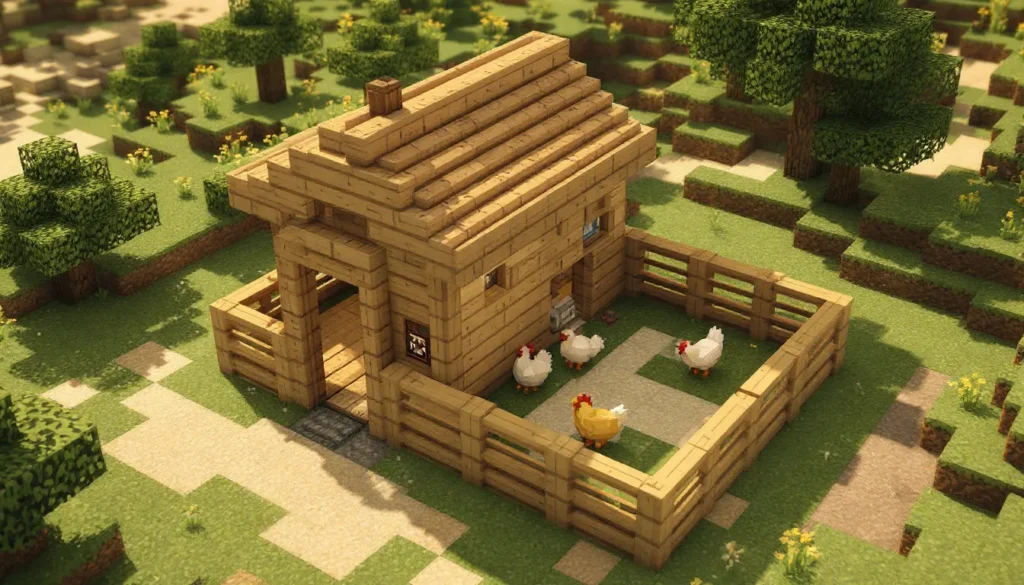
A chicken coop might seem like a basic early-game structure in Minecraft, but it’s actually the foundation of efficient farming and food production. Whether you’re building in vanilla survival mode or a modded instance, a well-designed Minecraft chicken coop streamlines egg collection, meat farming, and feather gathering while looking clean enough to fit into any base aesthetic. Players often underestimate how much a properly set-up coop improves their resource flow, the difference between hand-collecting eggs daily and watching them pile up automatically is massive. This guide walks through everything from initial site selection and material gathering through advanced automation systems, ensuring your operation runs like a well-oiled machine.
Key Takeaways
- A Minecraft chicken coop streamlines egg collection, meat farming, and feather gathering by confining chickens in a dedicated structure rather than letting them scatter across your base.
- Build your coop at least 3 blocks tall with secure fencing and double-gate access points to prevent escapes and maintain a functional, well-managed flock.
- Aim for a population of 20–50 chickens by feeding them seeds and breeding pairs with any seed type (wheat, beetroot, melon seeds) to sustain consistent resource generation without wasting feed.
- Automate egg collection using hoppers and chests placed beneath your coop floor to passively generate 150+ eggs per in-game day with minimal redstone knowledge required.
- Position your coop close to your main base on flat terrain with adequate lighting and a proper roof to create an efficient, attractive farm that generates renewable food and crafting resources indefinitely.
Why You Need a Chicken Coop in Minecraft
Chickens are arguably one of the most efficient mobs to farm in Minecraft. They drop eggs (which can be used for crafting or thrown to spawn baby chicks), raw chicken (for food), and feathers (essential for arrows and books). The sheer renewable nature of chickens means once you have a functioning breeding operation, you’ll never run out of these basic resources.
A dedicated coop also prevents chickens from spreading across your base, which can get chaotic fast. Confined chickens are easier to manage, breed in bulk, and harvest from. Beyond pure efficiency, a Minecraft chicken coop becomes the stepping stone toward larger farms, automated egg collection systems teach you about hoppers and item sorting, concepts you’ll use for wheat farms, mob grinders, and more.
For multiplayer servers or hardcore worlds, a reliable food source like an active chicken coop is non-negotiable. It’s one of the few early-game setups that pays dividends throughout the entire lifespan of a world.
Gathering Materials and Preparing Your Site
Basic Tools and Resources You’ll Need
You won’t need anything exotic to build a basic coop, but having the right tools speeds things up significantly. A wooden or stone axe is essential for gathering wood quickly, oak, birch, spruce, or dark oak all work fine. A shovel (wood or stone) lets you level terrain if needed. Beyond that, standard building materials include:
- Wood blocks (any type) for walls and frame
- Wooden planks for roofing and floors
- Fences for containment (crucial, don’t skip this)
- Fence gates for access points
- Slabs or stairs for roosting perches
- Doors for weather protection (optional but recommended)
- Torches or lanterns for lighting
For an automatic setup, you’ll eventually need hoppers, chests, and redstone, but basic coops don’t require any of that. If you’re going hardcore vanilla without mods, a stone pickaxe gets you started with basic material gathering in under an hour of playtime.
Choosing the Right Location
Location makes or breaks a coop’s long-term viability. Pick somewhere close to your main base, you don’t want to walk five hundred blocks just to collect eggs. Flat or near-flat terrain saves construction time: building on a slope wastes materials and looks sloppy. Avoid areas prone to mob spawning at night unless you plan to light everything up thoroughly. Near water is actually ideal, since water is useful for cleaning mobs and can be repurposed later.
If you’re on a server or multiplayer world, coordinate with teammates to avoid overlap. A single centralized farm is way more efficient than multiple scattered coops. On single-player, place the coop somewhere visible and accessible, tucked away in the corner of your base is fine, but “lost in the woods” creates frustration when you need eggs at night. Claim the area with torches or blocks so you remember where it is.
Step-by-Step Construction Guide
Building the Frame and Walls
Start by laying out your coop’s footprint. A 10×10 block base is a solid starting point, big enough to house 20–30 chickens comfortably without feeling cramped. Mark the corners with temporary blocks, then build the frame:
- Place a layer of wood blocks around the perimeter at ground level (this becomes your foundation).
- Build walls up to at least 3 blocks tall. Chickens can jump, but they can’t jump 3 full blocks, so this height prevents escapes.
- Leave planned openings for gates or access points, you’ll fill these with fence gates in the next step.
- Use a mix of wood types or solid blocks for visual interest. Stripped logs paired with planks looks cleaner than a solid cube of oak logs.
Don’t overthink aesthetics in the first draft. Function comes first, beauty second. A rectangular box works just fine while you’re learning.
Adding Fencing, Gates, and Access Points
This step is critical, sloppy fencing kills coops. Replace wall sections with fence blocks, not fence gates. Fence blocks form a secure perimeter that chickens can’t jump over. Leave 2–3 blocks as openings for gates:
- Install fence gates at each opening. These are your entry and exit points for managing the flock.
- Double-gate entries are ideal: one gate leads into a small “airlock” corridor, then another gate enters the main coop. This prevents chickens from bolting out when you open the door.
- Make sure gates open inward, not outward. This is a small detail that prevents frustration.
If you’re playing on a version with trapdoors, use those instead, they’re more compact and look better for small access points. Test the gates by trying to walk through while chickens are present. If any escape, you’ve found your weak point.
Roofing and Weatherproofing Your Coop
A roof serves two purposes: it prevents rain from bothering your lighting setup (cosmetic but important for immersion), and more importantly, it prevents hostile mobs from spawning inside at night if you leave the coop partially open or roofless.
- Cover the top with slabs or full blocks. Slabs are cheaper and look less imposing.
- If using slabs, place them on the upper half of the block so the coop still feels open inside.
- Leave small gaps for ventilation if you want (purely aesthetic, but it adds character).
- Add an overhang on one or two sides using stairs or slabs. This looks intentional and directs rain runoff.
Don’t seal it completely, chickens need air, and you need to see inside. Lighting before roofing prevents mob spawning anyway, so the roof is more about polish than survival mechanics.
Interior Setup and Design Elements
Creating Nesting Areas and Roosting Spots
Chickens don’t actually use nesting boxes the way real chickens do, but creating dedicated spaces makes the coop feel purposeful and helps with organization. Build roosting spots using slabs or stairs in corners:
- Place 3–4 slabs or stairs in a corner, stacked half-height. Chickens naturally gather here, especially if you light it well.
- Do this in 2–3 corners to distribute the flock and reduce crowding in one spot.
- Alternatively, use carpets on top of slabs to create simple perches. Chickens won’t actually roost on them, but it looks authentic.
For nesting areas, reserve a quiet section (maybe a corner with lower light) for breeding pairs. When you start breeding (more on that in the next section), isolate 2–3 pairs here temporarily. This speeds up reproduction and prevents chaos when baby chicks spawn.
Adding Lighting and Decorative Features
Light is essential for three reasons: it prevents mobs from spawning inside the coop, it makes the interior visible and pleasant, and it signals to visitors that this is a functional, maintained space.
- Place torches or lanterns around the perimeter, roughly one per wall. Lanterns are cleaner-looking and won’t catch fire if a creeper somehow gets inside.
- Use glow berries (if available in your version, added in 1.18+) for ambient hanging lights. They’re beautiful and serve no mechanical purpose, but they transform the coop from “box” to “home.”
- Add decorative elements: hay bales as feed storage, composters in one corner, flower pots with flowers. None of these are mechanical, but they sell the idea of a functional farm.
- Hang lanterns from chains if you’re playing 1.17 or later, this adds vertical interest and prevents harsh shadows.
The interior setup is where your Minecraft chicken coop goes from utilitarian to gallery-worthy. Take time here: you’ll pass through this space regularly.
Breeding and Managing Your Chicken Population
How to Attract and Breed Chickens
Getting chickens into your coop is the first step. Find wild chickens (they spawn in open grassy areas, usually in groups), then herd them toward your coop using seeds. Hold seeds in your hand and the chickens will follow you like a trail of ducklings. Lead them through your gates into the coop, then close the gates behind them.
Once you have chickens inside, breeding is straightforward:
- Hold seeds, wheat, beetroot seeds, or melon seeds in your hand.
- Target two chickens and feed both, they’ll enter “love mode” with red hearts appearing above their heads.
- Within seconds, a baby chick spawns between them. Both parents go on a 5-minute cooldown before they can breed again.
Baby chicks take 20 minutes to grow into adults (in regular game time: faster in multiplayer with higher server load). During this time, they don’t reproduce or drop items. Accelerate growth by feeding them seeds, each seed instantly ages them by 10%. This is helpful early on, but once you have a stable population, let nature take its course.
A population of 20–30 chickens is optimal. Beyond that, you’re wasting feed and cluttering the coop. Keep breeding under control once you hit your target number.
Feeding, Health, and Population Control
Chickens eat seeds automatically if they’re in the same space. Seeds are abundant, farming wheat and planting it, or collecting seeds from grass, gives you unlimited food. Chickens aren’t picky, so any seed type works.
Unlike real animals, Minecraft chickens don’t have health bars you need to manage. They’re essentially immortal unless killed. Population control happens in two ways:
Natural limits: If you stop feeding and breeding chickens, the population caps at around 60–80 before stalling. They don’t starve to death, they just stop breeding.
Active management: If you want precise population control for automation systems, periodically kill excess chickens using the platform-specific farming methods discussed in dedicated breeding guides. A simple lava channel or suffocation system works fine. Dark, crowded coops also stress chickens in some modded versions, encouraging natural depopulation.
In vanilla survival, most players feed chickens just enough to maintain a steady population of 30–50, ensuring consistent egg drops without resource waste.
Advanced Coop Features and Automation
Automatic Egg Collection Systems
Once you’ve mastered the basics, automate egg collection. This is where Minecraft chicken coop setups become genuinely impressive.
The classic hopper-and-chest system works like this:
- Build a narrow channel (1 block wide, 2 blocks tall) under part of your coop’s floor.
- Place hoppers in this channel, flowing toward a central point. Hoppers suck items up one block above them.
- At the end of the hopper line, place a chest or double chest. Eggs automatically flow into it.
- Remove the blocks above the hoppers so eggs dropped by chickens fall directly into them.
Chickens drop eggs roughly every 5–10 minutes on average, and hoppers process items faster than eggs spawn, so you won’t lose any. This system costs minimal redstone knowledge and transforms your coop into a passive income generator.
Advanced players build mob grinders that use fall damage or suffocation to harvest both eggs and meat simultaneously, routing everything through the same collection system. This requires more engineering but is incredibly satisfying once functional. Resources like Game8’s building guides break down these complex systems step-by-step if you want to go deeper.
Efficient Farming and Resource Generation
Once eggs auto-collect, eggs pile up fast. A modest coop with 30 chickens generates 150+ eggs per in-game day. Eggs aren’t stackable in all uses (you can’t just consume 64 eggs as food), but they’re invaluable for:
- Hatching baby chicks: Throw eggs and roughly 12.5% spawn a baby chick. Stack of 64 eggs = roughly 8 chicks.
- Crafting: Eggs are ingredients in cakes, pumpkin pies, and a few other recipes.
- Mob farm fuel: In some modded setups, eggs trigger specific mechanics.
Meat production scales with your population. A 30-chicken coop sustains one player’s food needs indefinitely, plus provides surplus for trading or storage. Feathers also accumulate, you’ll never need to hunt chickens for feathers again once the farm is running.
Optimize by feeding minimal seeds (just enough to maintain population) and harvesting meat only when you need it. This prevents over-breeding and keeps the coop performing efficiently. Monitor your storage chests: if eggs are piling up unused, dial back breeding.
Common Mistakes and How to Avoid Them
Undersized coops: A 5×5 coop quickly feels cramped with even 10 chickens. Build bigger than you think you need. Space = fewer pathing issues and less lag.
Forgetting the roof: Rain and mob spawning aren’t game-breakers, but an open coop feels incomplete and invites chaos at night. Budget time for a proper roof.
Poor gate design: Single gates let chickens escape when you’re not looking. Double-gate airlocks prevent this and look more professional.
Skipping lighting: Dark coops are hostile environments (literally, mobs can spawn). Torches cost almost nothing: there’s no reason to cheap out.
Overstocking: More chickens ≠ better coop. A crowded coop lags your game, wastes feed, and produces eggs faster than you can use them. Aim for 30–50 unless you have a specific goal.
Automatic systems without overflow protection: If your hopper system backs up, eggs disappear instead of storing. Use double chests or add a second collection line if throughput is high.
Not testing thoroughly: Build the coop, then spend 10 minutes trying to escape. If you can break out, so can a panicked chicken during breeding season.
Check Twinfinite’s guide walkthroughs for visuals on common pitfalls, sometimes seeing a problem clearly beats reading about it.
Conclusion
A Minecraft chicken coop is more than just a box full of birds, it’s the foundation of sustainable resource management and the entry point into farm automation. Whether you’re building a simple fenced area for a small survival world or a massive automated egg factory, the principles remain the same: solid containment, reliable breeding, and thoughtful design.
Start with basics: a walled enclosure, a few roosting spots, adequate lighting, and a steady breeding population. Once that’s running smoothly, layer in automation. Hoppers, chests, and redstone circuits transform a static coop into a machine that generates resources while you’re off exploring or building elsewhere.
The satisfaction of walking past a completed coop and seeing chests overflowing with eggs, feathers, and meat is hard to overstate. Your future self, the one standing in front of a crafting table needing arrows or cake ingredients, will absolutely thank you for the time invested now. Build it right the first time, and your Minecraft chicken coop becomes one of the most reliable assets in your world.
More Stories
Minecraft Slope Unblocked: The Complete Guide to Playing Anywhere in 2026
How to Build Epic Minecraft Skyscrapers: Design, Tips, and Techniques for 2026
How To Build An Epic Spruce House In Minecraft: The Complete 2026 Design Guide