
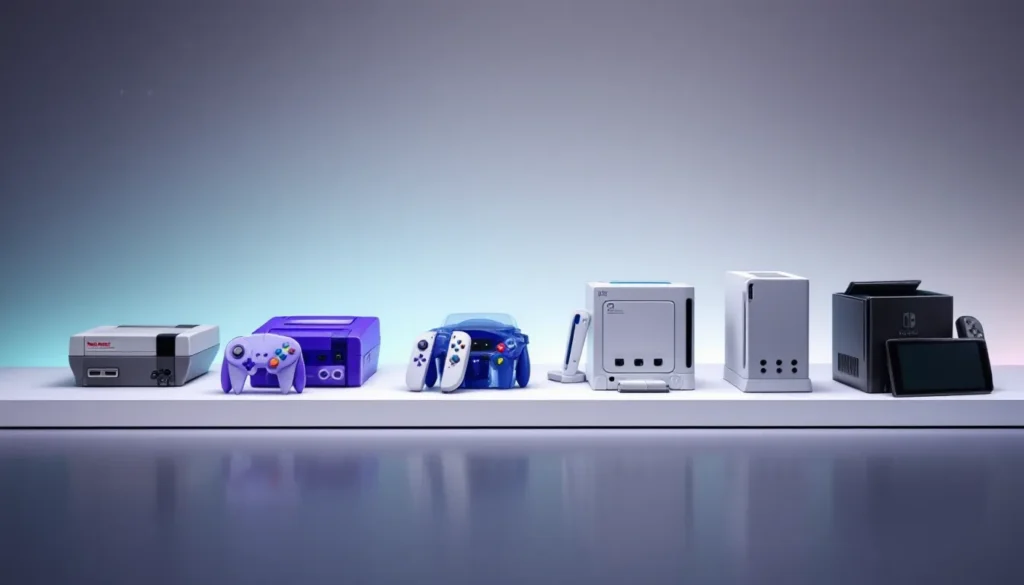
Nintendo’s been making gaming history for over four decades, and if you’ve picked up a controller in your lifetime, there’s a good chance it had the distinctive Nintendo logo on it. From the system that single-handedly revived the home console market after the crash of ’83 to the hybrid powerhouse that’s still dominating living rooms and commutes in 2026, Nintendo’s console lineup represents a journey through gaming’s most transformative eras. Whether you’re a collector hunting for rare cartridges, a gamer curious about gaming history, or someone who wants to understand why Nintendo shaped the industry the way it did, knowing the evolution of all Nintendo consoles gives you insight into why they’re still relevant today. This guide walks through every major Nintendo console release, from the NES to the Switch, covering what made each system special and why they matter to gaming as we know it.
Key Takeaways
- All Nintendo consoles have sold over 750 million units combined, proving the company’s enduring impact on the gaming industry since the NES saved home gaming from the 1983 crash.
- Nintendo prioritizes innovation in gameplay, interface, and user experience over raw processing power, from motion controls on the Wii to hybrid portability on the Switch.
- The Nintendo Switch has become the third best-selling console ever with over 139 million units sold, demonstrating that creative design and exclusive software matter more than technical specifications.
- Each Nintendo console generation introduced revolutionary features—the NES brought cartridge-based gaming, the SNES perfected 16-bit design, the N64 pioneered 3D controls, and the Wii redefined motion gaming for mainstream audiences.
- Nintendo’s handheld dominance through the Game Boy, DS, and 3DS proved that dedicated gaming devices with exclusive software libraries can compete with and outperform more technically advanced competitors.
- The upcoming Switch successor will likely continue Nintendo’s tradition of solving real gaming problems through interface innovation rather than pursuing the highest processing power available.
Nintendo’s Legendary Legacy
When most people think about why Nintendo matters to gaming, they’re touching on something deeper than just nostalgia. Nintendo didn’t just release consoles, they defined what a console could be, then redefined it repeatedly whenever the industry threatened to stagnate. The company’s willingness to take creative risks, from cartridges to motion controls to hybrid portability, kept them relevant while competitors scrambled to catch up.
The numbers tell part of the story. Nintendo’s consoles have sold over 750 million units combined across all platforms. But the real legacy isn’t in sales figures, it’s in the franchises and gameplay innovations that became the template for how we play games today. Mario, Zelda, Donkey Kong, Pokémon, Metroid: these weren’t just hit games, they were proof that hardware was only half the equation. Great games defined the generation, and Nintendo understood that better than anyone.
Each console iteration built on lessons from the previous generation, sometimes taking a step backward commercially to leap forward creatively. That’s the Nintendo way. And that’s why understanding all Nintendo consoles means understanding modern gaming itself.
The Home Console Revolution Begins
Nintendo Entertainment System (NES)
The Nintendo Entertainment System (1983-1985, depending on region) isn’t just the oldest Nintendo home console, it’s arguably the console that saved the entire home gaming industry from complete collapse. Before the NES, the video game crash of 1983 had decimated consumer confidence in home gaming. People were done with blurry pixels, shallow gameplay, and cartridges that didn’t work. Nintendo walked in with a system that felt premium, came with R.O.B. (Robotic Operating Buddy) to make it look like a toy rather than a computer, and launched with games that actually proved home gaming could be as engaging as arcade experiences.
Specs: The NES ran on a custom Ricoh 2A03 processor (essentially a modified 6502 architecture) with 2KB of RAM. That’s not a typo. Everything from Super Mario Bros. to The Legend of Zelda ran on 2KB of RAM. Resolution topped out at 256×240 pixels, and the color palette was limited to 53 colors visible on screen at once. By today’s standards, it’s shockingly primitive. By 1985 standards, it was magical.
The launch lineup included Super Mario Bros., Donkey Kong, and Excitebike. Super Mario Bros. alone sold over 40 million copies across all platforms and essentially became the system seller that proved the console’s worth. Within a few years, the NES wasn’t just successful, it had become the dominant console worldwide, pushing the failed Atari 2600 into irrelevance and establishing Nintendo as the house that saved home gaming.
The NES lasted officially until 1995 in North America, with an estimated 61.91 million units sold. It spawned countless classics: Mega Man, Castlevania, Contra, Metroid, Final Fantasy, and dozens more. The library became so extensive that it’s impossible to truly experience everything the system has to offer in a single lifetime.
Super Nintendo Entertainment System (SNES)
By 1990, when the Super Nintendo Entertainment System launched in Japan (1991 in North America), 16-bit gaming was the next frontier. The SNES wasn’t just a hardware upgrade, it was a statement that Nintendo could play in the same technical space as competitors while maintaining their software superiority.
Specs: The SNES ran a Ricoh 5A22 processor at 3.58 MHz with 128KB of RAM. That’s a 64x increase in memory from the NES, and the difference was immediately apparent. Colors jumped from 53 to 256 simultaneously on screen, with a palette of 32,768 possible colors. Sprites got bigger, animation got smoother, and the sound chip (S-SPC700) delivered audio that still holds up today.
The SNES library is often considered the goldest of golden eras. The Legend of Zelda: A Link to the Past remains one of the greatest games ever made. Super Mario World redefined platforming. Super Metroid basically invented the Metroidvania subgenre and perfected it in one shot. Add in Chrono Trigger, Final Fantasy VI, F-Zero, Street Fighter II, and you’ve got a lineup that any console would envy thirty years later.
The system sold over 49 million units and remained in production until 2003 in some regions. It competed directly with the Sega Genesis, and while the Genesis had flashier marketing and Sonic, the SNES won the war through sheer software depth. Third-party support was phenomenal, and even arcade ports that would’ve been butchered on other systems felt right on the SNES.
Nintendo 64 (N64)
The Nintendo 64 (1996-1998 launches, region dependent) marked Nintendo’s jump into 3D gaming, and it came with something nobody else had: Super Mario 64. That game essentially taught an entire generation how 3D platformers should control, and it’s still influential in 2026.
Specs: The N64 ran a custom R4300i processor at 93.75 MHz with 4MB of RAM. Graphics were handled by an SGI (Silicon Graphics Inc.) RSP co-processor, making the N64 one of the first consoles to use significantly outsourced GPU architecture. It could push polygons hard, but memory limitations meant texture clarity suffered compared to competitors like the PlayStation and Dreamcast.
The console cart-based approach meant shorter load times and instant gameplay, but storage was severely limited. A typical N64 cartridge held 32-64MB of data, compared to a PlayStation’s 650MB CD. This shaped game design, developers had to get creative with what they could fit, which sometimes resulted in innovative compression techniques and sometimes in truncated content that went to CD on other platforms.
The library, while smaller than the SNES’s, contained some of gaming’s most essential experiences. Super Mario 64, The Legend of Zelda: Ocarina of Time, Goldeneye 007, Perfect Dark, Mario Kart 64, Star Fox 64, these games defined a generation. Multiplayer on a single couch was the N64’s secret weapon. While other consoles were building online infrastructure, Nintendo was perfecting split-screen and four-player gaming that didn’t require a network connection.
The N64 sold 32.93 million units. It’s often seen as the console where Nintendo’s more experimental approach paid off creatively, even if the technical limitations started feeling constraining as the generation progressed.
The GameCube and Wii Era
Nintendo GameCube
The Nintendo GameCube (2001-2007) arrived during the PlayStation 2’s dominance and had a lot to prove. Nintendo went all-in on optical media (ditching cartridges entirely), introduced a revolutionary controller with a built-in rumble system, and aimed squarely at core gamers who felt the N64 had moved past them.
Specs: The GameCube ran an IBM PowerPC Gekko processor at 485 MHz with 24MB of 1T-SRAM. It was a legitimate powerhouse for its era, capable of rendering smooth, colorful 3D graphics at 480p. The optical drive spun backwards (literally novel technology at the time), which was quirky but allowed for reliable disc reading.
The controller was divisive. You either adapted to the unconventional button layout and the oversized A button, or you fought it for years. Many players never adjusted, but the controller design prioritized ergonomics and the rumble system’s strength in a way that became template-setting.
The GameCube’s library was smaller than its contemporaries but dense with quality. Super Smash Bros. Melee became esports-defining (it’s still played competitively in 2026, with an active tournament scene that treats Melee as a legitimate fighting game alongside modern titles). The Legend of Zelda: The Wind Waker was divisive (cel-shading, lots of sailing), but it’s aged into a masterpiece. Metroid Prime translated a 2D franchise flawlessly into 3D. F-Zero GX, Mario Kart: Double Dash, Fire Emblem: Path of Radiance, the library has legs.
Sales of 21.74 million units were respectable but felt small compared to the PS2’s 155+ million. Nintendo’s core gamer focus paid off in franchise loyalty but didn’t win the console war by volume. The GameCube was proof that Nintendo could compete on pure processing power but preferred to compete on creativity.
Nintendo Wii
The Nintendo Wii (2006-2013) is where Nintendo changed gaming forever. Instead of trying to outpower competitors, they invented a new way to play.
Specs: The Wii ran an IBM PowerPC Broadway processor at 729 MHz with 88MB of total memory. By late-generation standards, that was decidedly weak. But the innovation wasn’t in raw processing, it was in the motion controls. The Wiimote and Nunchuk attachment introduced gesture-based gaming to mainstream audiences. Grandmothers were playing bowling. Your dad was swinging a tennis racket at the TV. It wasn’t hardcore gaming, but it proved gaming could be for everyone.
Wii Sports was bundled with the console in many regions and became a cultural phenomenon. It wasn’t technically impressive, but it demonstrated motion controls in ways that made intuitive sense. You didn’t need to memorize button combos, you just moved the controller like you were actually playing the sport.
The Wii sold 101.63 million units, making it the third-best-selling console of all time (behind the PS2 and Nintendo DS). That number speaks volumes. This was Nintendo reaching beyond traditional gamers and proving the broader appeal of gaming. The library ranged from motion control novelties to serious titles like The Legend of Zelda: Twilight Princess and Metroid Prime 3, though many third-party titles felt like lazy cash-ins leveraging motion controls as a gimmick rather than an innovation.
The Wii proved that hardware specs aren’t everything. Innovation in how you play sometimes matters more than how many polygons you can push.
The Modern Console Generation
Wii U and Its Transition
The Nintendo Wii U (2012-2017) is the console Nintendo fans least like to discuss. It was genuinely ahead of its time, a home console with a massive touchscreen tablet as the primary controller, but the execution and marketing were confusing enough that casual audiences thought it was an accessory for the original Wii.
Specs: The Wii U ran a PowerPC multi-core processor at 1.24 GHz with 2GB of RAM (split between 1.5GB for the OS and 512MB for developers). The gamepad controller featured a 6.2-inch resistive touchscreen, allowing off-TV play that felt genuinely revolutionary at the time. The idea that you could play full home console games on the gamepad screen without needing a TV made sense for households with multiple people competing for screen time.
But Nintendo’s marketing fumbled the positioning. Consumers weren’t sure if the Wii U was a standalone console or an accessory. The controller was expensive and heavy. Multiplayer often required additional controllers you had to buy separately. Third-party support evaporated early. Performance-wise, the Wii U couldn’t keep up with the PS4 and Xbox One, which launched midway through its lifecycle and immediately made it feel outmatched.
The library had gems: The Legend of Zelda: Breath of the Wild (which launched on both Wii U and Switch), Mario Kart 8, Splatoon, Donkey Kong Country: Tropical Freeze. But the install base never reached critical mass. Only 13.56 million units sold, making it Nintendo’s worst-performing home console since the Virtual Boy.
Here’s the thing though: the Wii U’s gamepad concept wasn’t wrong, it just came too early and was marketed poorly. Nintendo Closing Wii U showed that Nintendo eventually gave up on the platform, but the core idea of asymmetrical gaming and off-TV play lived on in different forms.
Nintendo Switch and Switch Variants
The Nintendo Switch (2017-present) fixed everything the Wii U got wrong. It’s a hybrid console, portable handheld when you need it, traditional home console when you dock it. Simple, effective, revolutionary in its own way.
Specs (Original Switch): The Switch runs an NVIDIA Tegra X1 processor with 4GB of RAM. When docked, it outputs 1080p to your TV. Undocked, the screen is 6.2 inches at 720p. Storage was a modest 32GB (expandable via microSD), which felt tight until you realized most Switch games are smaller than AAA releases on other platforms. Battery life is 4.5-9 hours depending on usage.
The genius was the removable Joy-Con controllers. They plug into the console for handheld play, dock on the sides for TV play, or detach completely for multiplayer. It sounds simple, but it’s elegant design that changed console gaming.
The launch lineup was thin (basically The Legend of Zelda: Breath of the Wild and 1-2-Switch), but that one Zelda game was enough. Breath of the Wild proved that open-world design could work at 30fps with creative art direction replacing raw processing power. The game won every award and drove console adoption hard.
Then came the variants. The Switch Lite (2019) dropped the TV connection and the removable Joy-Cons in exchange for a $200 price point and full portability. It sold millions because not everyone needs TV docking. The Switch OLED (2021) upgraded the screen to OLED with better colors, added more storage, and improved the dock, a premium option for existing fans willing to upgrade. As of 2026, Nintendo’s also released specialized hardware like the Switch Sports Bundle and various color variants.
The Switch has sold over 139 million units, making it the third best-selling console ever (behind the PS2 and Nintendo DS). 9 Best Fighting Games for the Nintendo Switch highlights how diverse the library became, from The Legend of Zelda: Tears of the Kingdom to Splatoon 3 to Super Smash Bros. Ultimate to Animal Crossing: New Horizons, the Switch proved Nintendo could balance blockbuster exclusives with innovative new IPs.
The Switch’s longevity is remarkable. In 2026, Nintendo’s preparing the Switch successor, but the original console is still selling strong. That’s not usually how console cycles work, but Nintendo extended the lifespan through software support and strategic hardware variants.
Nintendo Handheld Systems
Game Boy to DS Dynasty
While Nintendo was dominating living rooms, they were building an equally dominant handheld empire. The Game Boy (1989-2008) wasn’t the most technically advanced handheld ever made. It had a monochrome green-tinted screen, chunky design, and battery life that measured in hours, not days. But it had Tetris, and Tetris sold Game Boys.
Game Boy Specs: Zilog Z80 processor at 4.19 MHz, 8KB of RAM, that infamous monochrome display. Resolution was only 160×144 pixels. By every technical metric, it lost to competition like the Atari Lynx and Sega Game Gear, which had full-color screens and significantly more processing power. But battery life was the killer feature, the Game Boy lasted on four AAs where competitors drained batteries like they were going out of style.
The Game Boy evolved through iterations (Game Boy Pocket in 1996, Game Boy Color in 1998), each refinement extending the platform’s lifespan. Pokémon launched in 1996 and became the system seller that defined a generation.
The Nintendo DS (2004-2013) took the handheld formula and added dual screens, a touchscreen bottom display, and wireless multiplayer. The specs were modest (ARM processor, 4MB RAM, 3-inch screens), but the innovation was staggering. Games like Touch. Generations titles and Nintendogs leveraged touchscreen controls in ways that felt genuinely new.
The DS became a massive phenomenon. Over 154 million units sold, making it the second-best-selling console of all time (behind only the PS2). The library was enormous: New Super Mario Bros., Mario Kart DS, Pokémon Diamond/Pearl, Brain Age, Professor Layton series. The DS proved handheld gaming could compete with home consoles in terms of sales and cultural impact.
3DS and Portable Innovation
The Nintendo 3DS (2011-2020) took the DS formula and added autostereoscopic 3D, glasses-free 3D gaming. The concept sounded gimmicky, but it worked surprisingly well. The screen showed two slightly different images to each eye, creating depth without special glasses.
3DS Specs: Dual ARM processors at 268 MHz, 128MB of RAM, dual 3.53-inch screens (bottom was capacitive touchscreen). The 3D screen had limitations, you had to sit at a specific angle to see the effect properly, and extended viewing sometimes caused eyestrain, but when positioned correctly, the 3D was genuinely immersive.
The 3DS library included ports and sequels that pushed the platform forward. The 10 Best Nintendo 3DS games demonstrated the variety: The Legend of Zelda: Ocarina of Time 3D remade an N64 classic in stereoscopic 3D, Fire Emblem: Awakening revitalized a franchise, Monster Hunter found a home on the system, and Pokémon Sun/Moon released exclusives that drove adoption.
The system sold 75.48 million units, a respectable number that proved handheld gaming still had legs. But the 3D gimmick never became essential to gameplay, it was more of a visual enhancement. By the time the Switch launched with hybrid portable/home functionality, the dedicated handheld market started contracting.
Nintendo’s handheld dominance shaped the entire portable gaming landscape. When other manufacturers competed directly (Sega Game Gear, PlayStation Vita, even the Steam Deck), they always found Nintendo’s established software library and consumer loyalty harder to overcome than raw hardware specs. The DS and 3DS proved that innovation in interface (touchscreen, 3D) and software library matter more than processor speed.
What’s Next for Nintendo Gaming
As of 2026, Nintendo’s preparing what’s expected to be a successor to the Switch. Details are limited, but the gaming industry’s already speculating about what direction Nintendo will take. Will it be another hybrid console? More powerful hardware? Something entirely new?
Historically, Nintendo doesn’t compete on specs. They innovate on gameplay, interface, or usage model. The Switch’s success was partly because it solved a real problem: people wanted console-quality games they could play anywhere. The next console will likely solve a different problem, though exactly what that is remains unclear.
Meanwhile, the Switch continues to receive major releases. The Legend of Zelda: Tears of the Kingdom launched in May 2023 and became an immediate classic, proving that even aging hardware can deliver cutting-edge gaming experiences with the right software. This strategy has worked for Nintendo: focus on exclusive franchises that leverage the hardware creatively rather than pushing technical boundaries.
Emulation and preservation of older Nintendo consoles has become an unexpected battlefield. According to various sources, including Nintendo Life’s coverage of retro gaming trends, player interest in classic Nintendo systems remains incredibly high. Nintendo’s released official options like Nintendo Switch Online with NES and SNES emulation, but demand for older systems exceeds supply. Retro game prices have climbed accordingly.
The handheld market’s evolution is interesting too. Gaming on phones killed dedicated handhelds for some players, but the Switch proved that dedicated hardware with exclusive software still has value. The next Nintendo handheld, whether it’s integrated into a home console or separate, will need to maintain that differentiation.
What’s certain is that Nintendo will continue prioritizing innovation in how we play over how much processing power we have. That’s been their playbook since the NES, and it’s unlikely to change.
Conclusion
Every Nintendo console tells a story about the gaming industry at that moment. The NES saved home gaming from oblivion. The SNES proved Nintendo could compete on technical ground while keeping the software advantage. The N64 showed that 3D gaming required rethinking everything about how controls work. The GameCube demonstrated that hardcore gamers still mattered. The Wii proved that gaming could reach audiences beyond traditional players. The Wii U taught Nintendo that marketing matters as much as innovation. The Switch showed that hybrid functionality could redefine what a console means.
Looking across all Nintendo consoles, from the earliest cartridge systems to the current hybrid powerhouse, the pattern is clear: Nintendo doesn’t always play it safe, and they don’t always win commercially, but they consistently push the medium forward. Whether it’s a motion controller, a touchscreen, glasses-free 3D, or a dock that transforms your handheld into a home console, Nintendo’s willingness to experiment keeps gaming fresh.
For anyone collecting, gaming, or just curious about the history that shaped modern gaming, all Nintendo consoles represent a journey worth understanding. They’re not always the most powerful machines, but they’re almost always the most interesting.
More Stories
SweetDiscord.com Consoles: How To Find, Use, And Troubleshoot Console Pages (2026 Guide)
SweetDiscord.com Consoles: The Friendly Guide To Buying, Setting Up, And Securing Your Next Console (2026)
Reef Quest Esports Console Review 2026: Is It Worth Buying?