
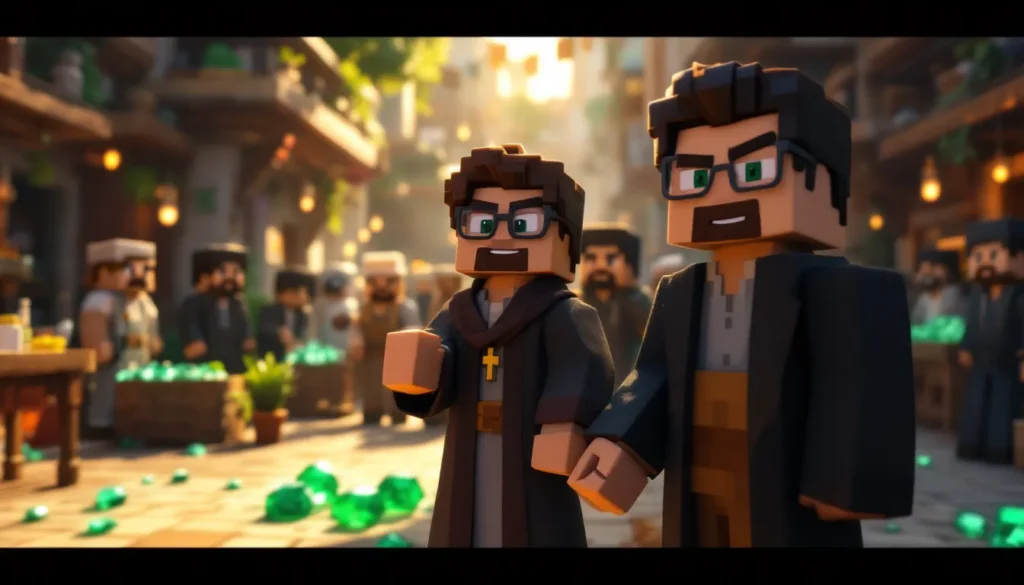
The Minecraft movie has finally brought the blocky world to the big screen, and with it comes one of the game’s most iconic yet mysterious NPCs: villagers. These robe-wearing traders have been a staple of Minecraft since their introduction, handling commerce, breeding, and general ambiance in the game. But the movie version? That’s a different beast entirely. The film reimagines these simple NPCs as full characters with personalities, motivations, and actual roles in the narrative, a departure from their mostly silent, trading-focused existence in-game. Whether you’re a longtime player curious about how the movie adapted your favorite emerald-hoarding merchants or a casual viewer wondering what the fuss is about, this breakdown covers everything the Minecraft movie reveals about villagers and how they compare to their digital counterparts.
Key Takeaways
- The Minecraft movie transforms villagers from silent trading NPCs into fully developed characters with personalities, motivations, and active roles in the storyline.
- Movie villagers retain iconic features like robes while gaining expressive faces and profession-specific designs that visually distinguish librarians from farmers and clerics.
- The film balances authenticity by layering intelligible dialogue over the classic ‘huh, huh, huh’ villager sounds while giving each character distinct voice acting and accents.
- Villagers drive the Minecraft movie’s plot by forming communities that face real stakes, serving as exposition sources for lore, and creating emotional investment through personal relationships with the protagonist.
- The film establishes explicit lore and civilization for the Minecraft universe by portraying villages as functioning societies with economies and social systems, which may influence future game updates and media adaptations.
What Role Do Villagers Play In The Minecraft Movie
In the Minecraft movie, villagers transition from background NPCs to active participants in the story. Rather than simply standing in their workstations waiting for trades, movie villagers serve as guides, allies, and obstacles depending on the scene. They’re woven into the film’s exploration of Minecraft’s society and structure.
The villagers function as a representation of civilization within the overworld. They establish communities, maintain infrastructure, and represent the organized world that contrasts with the chaotic forces of the Nether and hostile mobs. This narrative purpose gives them weight that the game’s basic mechanics don’t require. In-game villagers are efficient trade machines: in the film, they’re characters with stakes in the world around them.
Their role becomes particularly important when the story focuses on defending populated areas or building alliances against threats. Villagers aren’t just decorative NPCs, they’re integral to showing what players are actually protecting when they build and expand in Minecraft. This mirrors the actual gameplay experience where many players create villages as safe havens and trading hubs, making the film’s emphasis on villager communities feel authentic to how the game is actually played.
Villager Character Design And Appearance
The movie took significant creative liberties with how villagers look compared to their in-game models. While the game keeps them relatively simple, robed humanoids with large noses and minimal detail, the film renders them with considerably more personality and visual distinction.
In the movie, villagers retain their iconic robes but gain more expressive features and varied designs based on their profession. A librarian looks distinctly different from a farmer or a cleric, with costume details that signal their role. Their faces are more detailed, allowing for genuine expressions during dialogue and interactions. The blocky proportions of the game are smoothed out just enough to make them feel like actual characters rather than walking voxel clusters.
How The Movie Interprets Classic Game Mechanics
The movie addresses the game’s profession system, which is one of the most mechanically important aspects of villagers. In Minecraft, villagers adopt professions based on nearby job site blocks, a librarian needs a lectern, a farmer needs composters, etc. The film visualizes this system by showing villagers actively working at these stations rather than just standing idle.
Their appearance actually reflects their profession more obviously in the movie. A librarian wears spectacles and more scholarly robes. A farmer sports work boots and practical clothing. These visual cues help audiences instantly understand what each villager does without needing to understand Minecraft’s complex profession mechanics. It’s a smart translation of game systems into visual storytelling.
The movie also plays with the idea of villager customization through appearance. Different professions and experience levels manifest visually, which doesn’t happen in the game the same way. While in-game villagers look virtually identical aside from robe colors tied to professions, the movie makes each profession feel genuinely distinct.
Villager Voices And Voice Acting
One of the biggest changes from game to film is giving villagers actual voices. In Minecraft, villagers make the famous “huh, huh, huh” sounds, trading noises that became iconic to players. The movie had to decide how to handle this.
The film doesn’t completely abandon the original villager sound effects. Instead, it layers actual dialogue over or around the characteristic villager vocalizations, creating a hybrid approach. Some villagers speak in intelligible language, while others retain more of their game-like “hmm” and “huh” sounds depending on context and scene. This balances authenticity to the source material with the practical need for characters to communicate plot points.
The voice acting for speaking villagers brings genuine character to what were previously silent NPCs. Actors give villagers distinct personalities and accents based on their role. A merchant might sound shrewd and calculating, while a librarian could sound nerdy or professorial. These vocal choices help the audience form quick impressions of each character without needing extensive exposition.
This decision respects the game while making the film feel like its own adaptation rather than a direct copy. Players recognize the classic villager sounds, which provides continuity, but audiences unfamiliar with Minecraft still understand what’s being communicated.
The Storyline Impact Of Villager NPCs
Villagers aren’t just window dressing in the Minecraft movie, they drive parts of the plot. Their communities face threats, their knowledge becomes crucial to the protagonist’s journey, and their fate ties directly to the main conflict.
The film treats village attacks with genuine stakes. In Minecraft, raids happen regularly and players can defend villages with basic combat. The movie escalates this, showing village destruction as something consequential and tragic rather than just another encounter mechanic. When hostile mobs threaten villager communities, it matters narratively, not just mechanically.
Villagers also serve as exposition vessels, which works because they’re inhabitants of the world. Characters can ask villagers questions about the game’s lore, mechanics, or geography. A librarian might explain something about the world’s history or structure. A farmer might provide information about survival or agriculture. This feels natural rather than forced exposition dumps, since villagers would logically have knowledge about their world.
Some villagers become personal connections for the main character. They’re not faceless NPCs anymore, they’re individuals with names, personalities, and relationships. This investment in villager characters gives emotional weight to the film’s stakes and makes the protagonist’s actions feel motivated by more than just gameplay objectives.
Comparing Game Villagers To Movie Versions
The gap between how villagers function in Minecraft and how they’re portrayed in the film is substantial. Understanding these differences highlights what the movie chose to emphasize and what it simplified.
Key Differences In Behavior And Personality
In-game villagers are governed by strict AI routines. They wake up, work at job sites, socialize, sleep, and repeat. They don’t form complex relationships or express nuanced emotions beyond basic sounds. The movie villagers, by contrast, display genuine personality. They have conversations, show fear or courage in response to threats, and make autonomous decisions.
Game villagers rarely leave their villages voluntarily. They’re tied to their settlements and don’t venture far without player intervention. Movie villagers can travel, explore, and make choices about where they go and what they do. This gives them agency that the game’s mechanics don’t permit.
The movie also introduces conflict between villagers and other factions, which doesn’t really exist in-game. Villagers are universally neutral to players (unless hit), but the film creates tension and competing interests. Some villagers might have different goals or ideologies, creating drama that the game never explores.
Trading And Commerce In The Film
Trade is fundamental to villager identity in Minecraft. Players rely on villager trades to obtain rare items, enchanted books, and critical resources. The movie acknowledges this but presents it differently.
Instead of the game’s straightforward exchange system, player gives items, villager gives items, the film portrays trade as actual negotiation. Villagers have reasons for their trades, not just fixed rates. A librarian wants payment because they’ve invested in knowledge. A merchant seeks profit to support their village. This adds economic logic to what the game treats as pure mechanics.
Emeralds, the in-game currency for villager trades, remain important in the film. Their status as the universal trade good is preserved, though the movie might explain why emeralds hold value differently than the game does. The movie respects the mechanical importance of emeralds while grounding them in the world’s logic.
Fan Reactions And Community Response
The gaming community had mixed reactions to how the film portrayed villagers. Longtime Minecraft players had specific expectations based on thousands of hours with the actual game, while newcomers judged the characters purely on cinematic merit.
Many players appreciated that the movie gave villagers personality rather than keeping them as silent merchant automatons. The transformation from background NPCs to actual characters felt rewarding for people who’d spent hundreds of hours relying on villages and trades. Seeing villagers as three-dimensional beings validated a core part of the Minecraft experience.
But, some purists argued that too much was changed. They felt the movie’s villagers lost the mysterious, uncanny quality that made in-game villagers compelling in their simplicity. The game’s minimal villager personalities allow for player interpretation and imagination, the movie replaces that with explicit character development.
Community discussions on gaming forums and platforms like Polygon have highlighted how the film reveals what different players value about Minecraft’s design. Some love the film’s approach, others prefer the game’s restraint. This divide reflects a broader conversation about how video game adaptations should balance fidelity to source material with cinematic storytelling needs.
The general consensus from gaming media coverage acknowledges the film made a calculated choice to humanize previously mechanical NPCs, which works for mainstream audiences even if it disappointed some game purists.
What This Means For The Minecraft Universe
The film’s portrayal of villagers has broader implications for how the Minecraft universe is understood both in and outside the game. It establishes lore and consistency that the game itself never explicitly defined.
By giving villagers clear motivations, relationships, and hierarchies, the movie establishes that the Minecraft world has actual civilization and culture. This wasn’t explicitly stated in the game, though players inferred it. The film makes it canonical that villages aren’t just gameplay structures, they’re functioning societies with economies and social systems.
This could influence future Minecraft updates or spin-off media. If Mojang Studios continues the film universe or creates sequels, they now have established canon about how villagers think, act, and relate to each other. The film essentially backdates lore that the game had left deliberately vague.
For players, the film provides a new lens for interpreting their gameplay. When building villages or trading with NPCs, players might now imagine the characters the movie created. This enriches the imaginative aspect of Minecraft that’s always been central to its appeal. Coverage from outlets like IGN has noted how the film respects the game’s creative foundation while adding new dimensions.
The movie also legitimizes the idea that Minecraft’s simple aesthetics and mechanics contain room for deep storytelling. The film proves you don’t need to completely reinvent the game’s world to make compelling cinema, respectful adaptation can work. This might encourage more thoughtful video game film adaptations going forward rather than the dramatic overhauls some franchises have received.
Conclusion
Villagers in the Minecraft movie represent one of the biggest creative choices the filmmakers made, transforming silent, mechanical NPCs into full characters with agency and personality. The film managed to preserve what made villagers iconic in the game while expanding them into beings that work for cinema audiences.
The changes range from visual design to voice acting to narrative importance. Each decision balances respect for the source material with practical filmmaking needs. Villagers became essential to the story, not just background elements, which elevated their significance compared to their in-game role.
For gamers, the film offers a new perspective on Minecraft’s world and the communities players build within it. Whether viewers loved or critiqued how villagers were adapted, the film demonstrated that even the game’s simplest mechanics contain potential for rich storytelling. The villager portrayal will likely stick with audiences as the most tangible representation of Minecraft’s surprisingly deep potential for character-driven narratives, earning the movie recognition from gaming press outlets like NME Gaming for its thoughtful approach to adaptation.
As Minecraft continues to evolve and expand, the precedent set by the film’s villager characterization might influence how future updates or media portray the game’s NPCs. For now, the movie version of villagers stands as a compelling answer to the question: what happens when you give game mechanics genuine personality?
More Stories
How To Tame A Parrot In Minecraft — Quick, Reliable Steps + Sharing On SweetDiscord (2026)
Minecraft Slope Unblocked: The Complete Guide to Playing Anywhere in 2026
How to Build Epic Minecraft Skyscrapers: Design, Tips, and Techniques for 2026